
Stepping from fairness in principle to fairness in practice
Watertrust’s investment in fairness has had an important early test alongside some practical tools for people who work in contested water spaces.
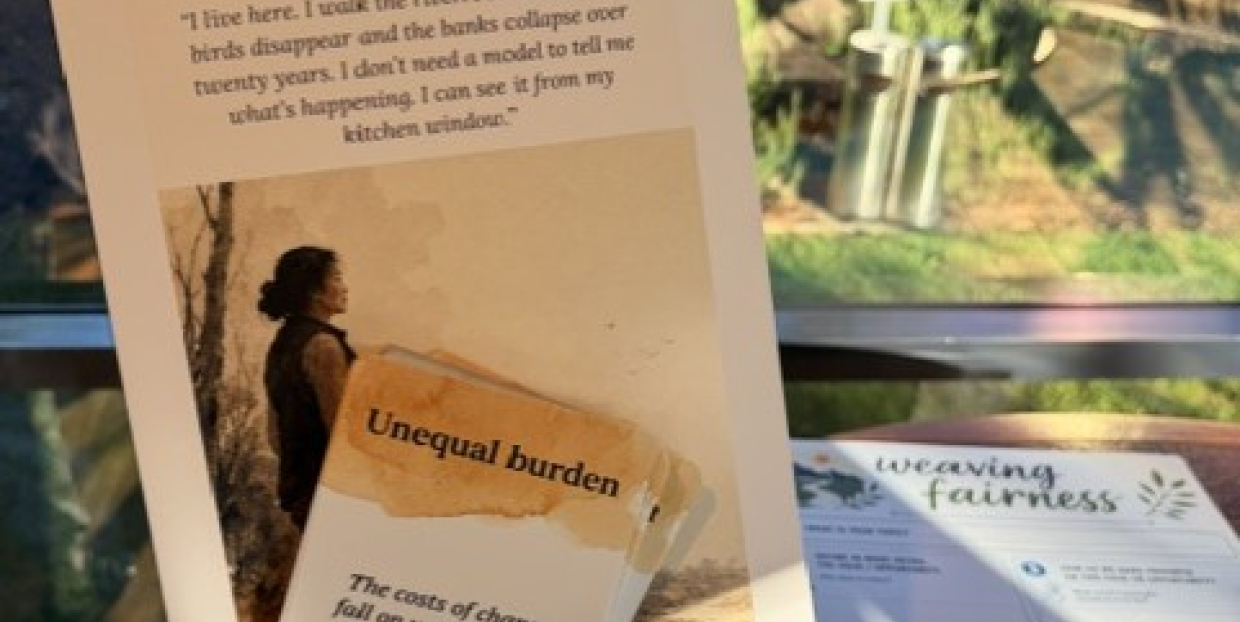
At a recent Peter Cullen Trust workshop for Fellows in Adelaide, Watertrust tested a new approach to framing fairness conversations with people who have different roles and experiences in water decision-making.
Monique White, Assistant Director of Engagement at the Murray-Darling Basin Authority, had been aware of Watertrust’s work on fairness before the workshop. She anticipated getting a close-up view and seeing whether its uses translate to the day-to day.
“What stood out was the way the workshop asked participants to step into different roles and consider what fairness might look like from someone else’s position,” Monique said.
“That matters in contested water settings, where broad labels like ‘government’, ‘community’, ‘industry’ and ‘the environment’ can hide the very different starting points people bring to a decision.”
Monique reflected that in Basin-scale decisions, people can understandably focus on what a decision means for them locally. But a fairness process could help widen the conversation by asking who else is affected, and what consequences might follow.
“It wouldn’t make disagreement disappear, but it could help people see whether they are disagreeing about evidence, values, risk, power, consequences or trust,” she says.
Maria Rosier, Director of Strategy and Policy at Natural Resource Management (NRM) Regions Queensland brought a different perspective, grounded in her experience in reef catchment planning and policy engagement.
Maria described working in settings where people arrive with distrust, exhaustion and strong emotion. She says in these circumstances the real work is not simply explaining policy or collecting feedback, but understanding why people feel the way they do and creating conditions where they can help shape something meaningful.
“For me the workshop highlighted how much people’s view of fairness can depend on whether they feel they have any real influence over the decision,” she said.
During the workshop, participants were asked to play different roles relevant to making water policy decisions. Maria was given the role of a Minister.
“I saw how quickly others looked to that role for answers and accountability, which was a reminder that people can be invited into a process while the power to act still sits somewhere else,” Maria says.
This is an important insight, because fairness is not only about helping stakeholders understand each other. It is also about whether institutions are actually willing to create room for people’s perspectives to genuinely matter.
Maria saw strength in the ideas in Watertrust’s Fairness work, but also pointed to the more difficult question of how they are used. She makes the case that an important test for the value of this work is whether institutions are prepared to listen carefully, resource the work properly, and allow people’s perspectives to shape how difficult decisions are worked through.
These insights from Monique and Maria show why the Peter Cullen Trust workshop was a valuable exercise for Watertrust. The room was informed, generous and experienced, and participants understood the complexity of water decisions well enough to provide useful, practical feedback.
This has given Watertrust a clearer sense of what is working, what needs refining, and how a fairness lens might support more difficult conversations in the future. The feedback also reinforced that no tool kit, however well designed, can do the work on its own. Fairness needs to be supported by leadership, time, skill and a genuine willingness to let people’s perspectives shape the way a decision is worked through.
The fairness tool kit will continue to be refined through feedback, testing and application.
Want to know more? Call Chris via our office number: 0480 654 380
Read our newsletter here or join our mailing list now to stay up to date with the latest news from Watertrust Australia.